

Little pandas.
Clear rules.
The economy behind Bamboo Riot: activation, funded distributions and a grove that grows with your collection.
Documented mechanics, adapted to our 4,000 pandas and original world.
Start with your panda.
Bamboo Riot is a collection of 4,000 pixel pandas, including ten one-of-one artworks. The NFT mint is free. Activating a panda later is a separate payment in the project token; it uses the NFT you already own.
Every panda has the same selectable activation ladder. Clothing, artwork rarity, one-of-one status and scenery add no financial multiplier. The tier you choose determines relative participation weight.
- Day 01Free mint + same-day reveal
- Day 02Token launch on Pons
- Day 03Staking opens
Days are counted from mint day. Exact times will be announced by @BambooRiot.
Current status: interactive preview and economic design. Wallet activation and financial distributions are not live in this preview.
Choose your activation tier.
The following prices and weights follow the StonkBrokers activation reference. Costs are in whole units of the future Bamboo Riot project token.
| Tier | Full activation | Weight | vs. Base | Upgrade from previous |
|---|---|---|---|---|
| Base | 66,666 | 100 | 1.00× | — |
| T1 | 166,666 | 125 | 1.25× | 100,000 |
| T2 | 366,666 | 160 | 1.60× | 200,000 |
| T3 | 666,666 | 200 | 2.00× | 300,000 |
| T4 | 1,666,666 | 333 | 3.33× | 1,000,000 |
50% protocol.
For a Base activation, 33,333 tokens go to burn and 33,333 to the protocol. The protocol half remains project tokens; it is not automatically ETH or a reward reserve.
Upgrades cost the difference.
An active panda pays the target tier’s full fee minus its current tier’s full fee. You can skip tiers. Base → T4 costs 1,600,000 additional tokens. Together with the original Base payment, this equals the direct T4 price. A current or lower tier is not an upgrade.
Weight is a relative share.
For a simple funded pool using the same reward asset, an eligible panda’s share follows its weight divided by the total eligible weight. As more weight participates, an existing panda receives a smaller percentage of that fixed pool.
T4 costs about 25 times Base and has 3.33 times its weight. These figures are allocation weights, not APR, fixed payouts or a promise of better returns per token spent.
Compare activation quotes ↗Rewards start with funding.
Distributions depend on funds actually received by the reward system. The intended flow follows the reference’s funded Clock In model: reserve a budget, acquire the requested assets when needed, then distribute confirmed inventory by eligible weight and asset selections.
- 01Receive fees
Count net funds that actually reach the reward fund.
- 02Fund a round
Reserve the available budget and acquire supported assets.
- 03Credit NFT vaults
Allocate the confirmed assets to eligible pandas.
The design allows up to three approved reward assets, with chosen allocations totaling 100%. The reference’s default without an election is ETH. The actual Bamboo Riot Stock Token menu and acquisition routes remain to be confirmed.
No new funding means no new funded distribution. Burning project tokens does not buy reward assets. Stock Tokens are also not automatically direct share ownership or corporate dividends; any supported instrument follows its issuer’s terms.
Where does the reference get its fees?
StonkBrokers has several products. Its core Anvil marketplace quotes a 10% swap fee or 15% snipe fee, paid in ETH. That fee splits 70% to StockBooster and 30% to the protocol. The token trade principal is separate.
The 70/30 rule is specific to that reference venue. It is not the activation split, a universal Pons token tax or an existing Bamboo Riot income stream. Other reference products, including loans and lockers, have their own rules.
Pons is our planned token launch venue. A launch there does not create StonkBrokers’ marketplace, lending products or their revenue. Bamboo Riot distributions will require its own verified fee sources and funded acquisition routes.
How the local model handles a round
The local model fixes active IDs, weights and asset selections at round opening, accounts in exact integer units, and prevents the same credit from being delivered twice. Snapshot timing, pending credits after a transfer and stored elections are original preview choices pending contract-level verification. No specific production pot threshold or payment interval has been promised.
The vault belongs to the NFT.
The reference uses an ERC-6551 token-bound wallet: assets already delivered to that wallet travel with the NFT. Bamboo Riot’s intended design follows this ownership model. The current NFT owner controls withdrawals.
Activation resets.
The delivered assets stay with the panda.
The new owner pays the full price of their chosen tier to reactivate. Previous activation payments do not become transferable fee credit. The previous owner loses authority over the NFT vault.
Deactivation does not erase assets already held in the vault. A sale transfers control of those assets; their balance may change before a sale if the seller withdraws them.
The exact treatment of pending, undelivered credits and saved reward choices must be finalized before launch. The local model preserves these with the NFT, but that pending-state behavior has not been independently verified against the reference contracts.
“Staking” is the project-facing label for the experience. The reference establishes activation and an NFT-bound wallet; it does not by itself establish a conventional custody deposit, an unstake timer or a lock period for this project.
A little forest for every crew.
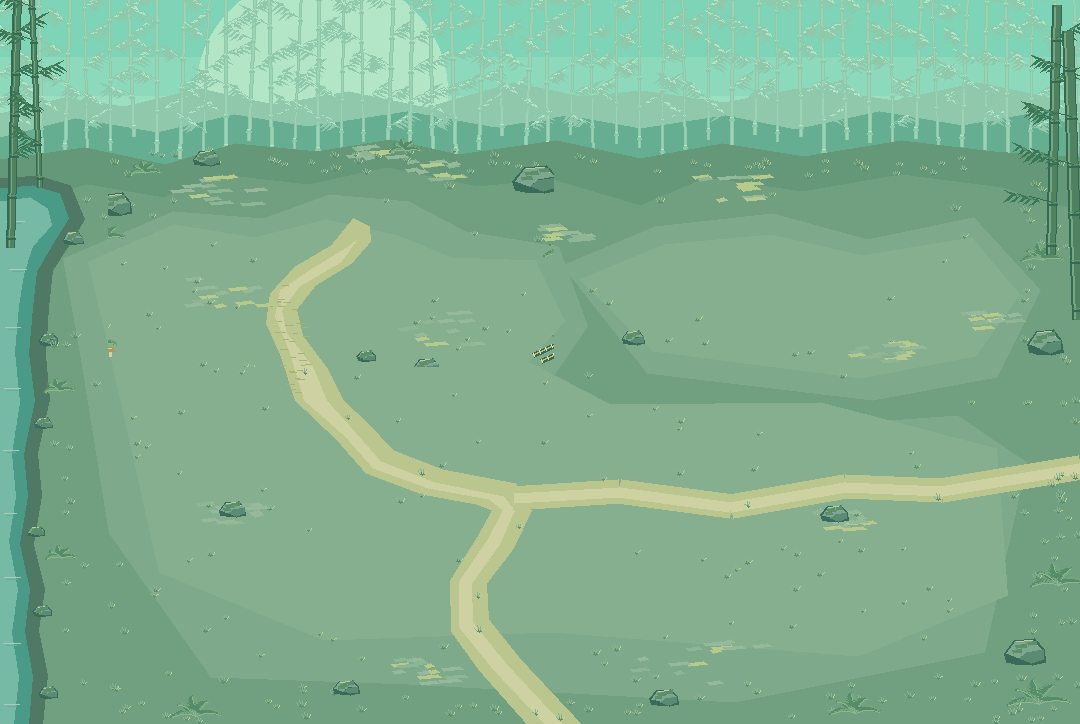 20 COLLECTION LANDSCAPES
Every panda in the preview tends its own bamboo patch. Districts hold up to 15 pandas, so larger collections stay easy to explore. The system can preview all 4,000 IDs without drawing the entire collection at once.
More pandas uncover more of the twenty environments from the NFT collection. These discovery thresholds are preview settings. Bamboo growth, cutting, carrying, unlocked worlds and time spent in the browser do not calculate or issue rewards.
The finished experience will use confirmed activation data to decide which pandas appear. The current preview uses example NFT IDs.
Explore the STAKE preview ↗Higher tiers use more tokens.
The chosen fee ladder allows limited aggregate capacity at the highest tiers. The project does not require every one of the 4,000 pandas to reach T4. This is independent of artwork rarity: no fixed T4 allocation, first-come quota or number of T4 slots has been announced.
The actual launch supply, factory settings and burn support still need verification. No token ticker, deployed contract or total supply is asserted by this preview. A transfer to a dead address is not automatically the same as reducing an ERC-20’s total supply.
See the collection-wide arithmetic
One Base activation for all 4,000 pandas would total 266,664,000 tokens, including 133,332,000 burned. If all reached T4 once, gross payments would total 6,666,664,000 tokens, including 3,333,332,000 burned. Reactivation after a transfer adds new consumption. Recirculating the protocol half does not restore burned tokens.
If the launch factory required a fixed one-billion supply, this exact burn schedule could not support all 4,000 reaching T4. Limited top-tier capacity is accepted in the design; the actual launch parameters remain to be verified.
Our economic reference.
StonkBrokers is the source of the selected economic mechanics: activation prices, relative weights, differential upgrades, the default 50/50 activation split and the NFT-bound vault concept.
We checked its official documentation and public activation interface on September 21, 2026. This is an independently built Bamboo Riot design with its own art and world. Reference contract storage was not independently verified, and matching selected rules does not establish full contract or revenue-source parity. No affiliation or shared revenue is claimed.
What is ready, and what is next?
The approved panda art, twenty grove environments, large-crew districts, tier quotes and this economic design.
Verified token settings, original on-chain activation and vault adapters, asset eligibility, funded acquisition routes, ownership rules and contract review.
The source code of StonkBrokers’ protocol has its own licensing terms. The local Bamboo Riot model is independently written; studying the economics is not a claim that those contracts have been copied or deployed.
View dated source evidence ↗